- Verify a BI licence
- Compare the final rupiah amount
- Avoid costly card conversion
- Know cash declaration rules
Know the currency before you arrive
Indonesia's currency is the Indonesian rupiah, written as IDR or Rp. Bank Indonesia requires rupiah for most cash and non-cash payment transactions inside Indonesia, subject to limited legal exceptions. Prices for ordinary travel purchases should therefore be quoted and settled in rupiah rather than US dollars or another foreign currency.
Cards and digital payments are common in cities and established tourism areas, but cash remains useful at small warungs, markets, parking areas, local transport points, and remote destinations. A practical approach is to carry a modest amount of rupiah while keeping cards and reserve funds separate.
- IDR is the international currency code; Rp is the local symbol.
- Count the zeros carefully before confirming a payment.
- Do not rely on one card or one source of cash.
Use a licensed bank or authorised money changer
For cash exchange, use a bank that offers foreign-exchange services or a non-bank money changer licensed by Bank Indonesia. An authorised non-bank provider should display its Bank Indonesia licence, official authorised-money-changer wording, business identity, and permit information. In Bali, official visitor guidance also tells travellers to look for the permit number and Bank Indonesia QR-code logo.
Do not judge legitimacy by an air-conditioned office, a calculator, or a professional-looking rate board. Verify the legal business name and operational status in Bank Indonesia's current list of licensed institutions when possible. A hotel or airport counter can be convenient for a small arrival amount, but compare its final rate with other licensed options before exchanging more.
Compare the amount you receive, not the headline rate
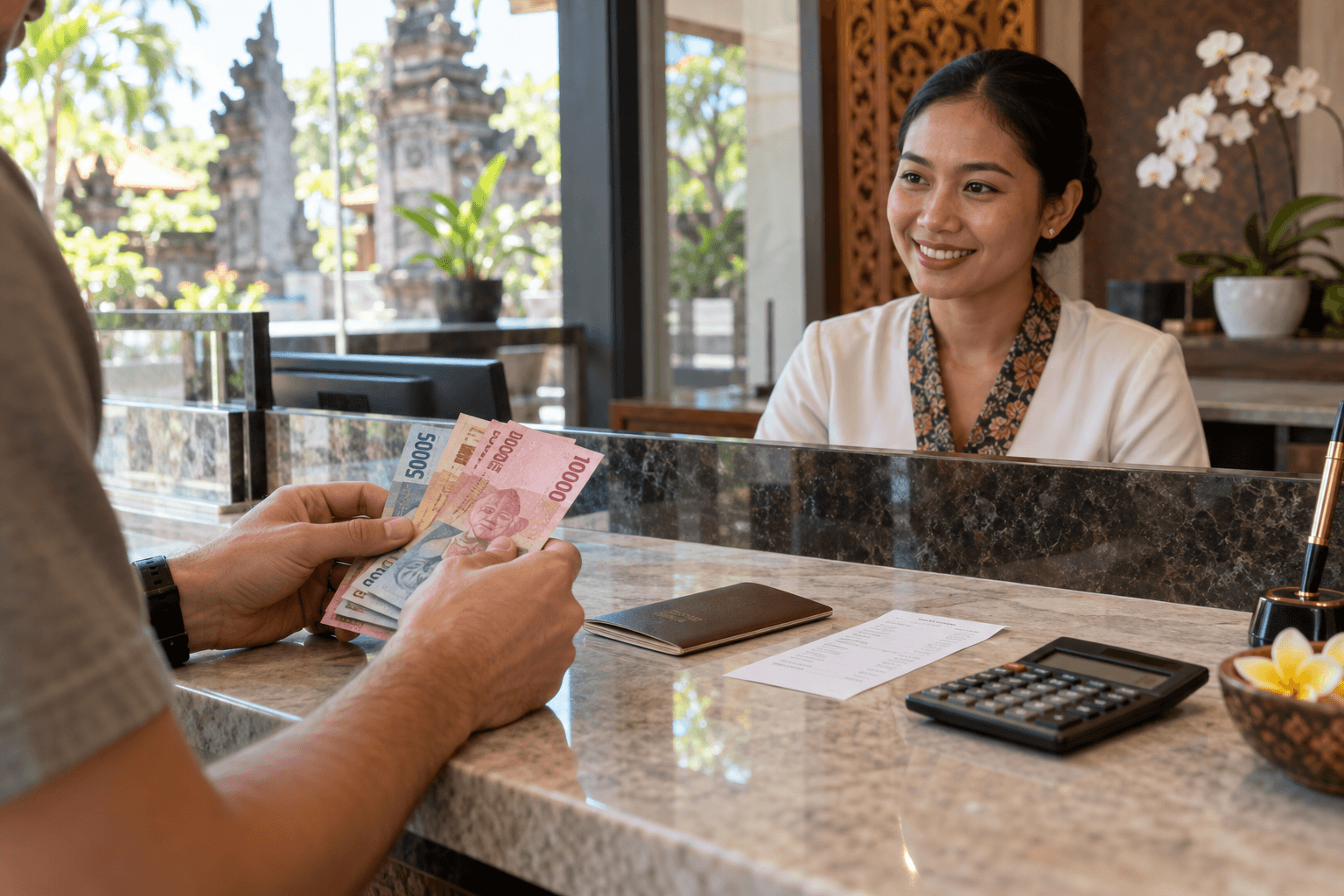
When converting foreign cash into rupiah, the relevant board figure is normally the money changer's buying rate because it is buying your foreign currency. Ask the cashier to write down the rate and exact rupiah total before handing over any notes. Compare that final total between providers on the same day, because market rates move and each provider sets its retail spread.
Bank Indonesia's consumer information says licensed non-bank money changers must show rates transparently and may not charge consumers a separate fee. Banks, card issuers, and other services can have different pricing structures, so confirm their terms. A claim of ‘no commission’ does not automatically mean the best deal when the exchange rate itself is poor.
- Use the same foreign-currency amount for every comparison.
- Ask whether different denominations receive different rates.
- Walk away if the final rupiah amount changes during the transaction.
Bring identification and protect the receipt
Bring your passport or another identity document accepted by the provider. Licensed businesses apply customer-identification and anti-money-laundering controls, and requirements can depend on the transaction. Let staff inspect the document, but do not leave your passport as security or allow unnecessary copies without an explanation.
Foreign banknotes may receive a lower rate or be refused when damaged, heavily marked, torn, or difficult to authenticate. Acceptance policies for older series and particular denominations differ, so there is no universal rule that every pre-2013 US dollar note is invalid. Ask the licensed provider rather than relying on a street claim.
Before leaving, count the rupiah yourself at the counter, check each denomination, and keep the receipt showing the provider, currencies, rate, and total. Do not let anyone handle or recount the money after you have completed your own count unless the full transaction is restarted in clear view.
Using an ATM in Indonesia
ATMs can be convenient when your international card is enabled for Indonesia, but the total cost may include an ATM fee, your home bank's withdrawal fee, and a foreign-exchange margin. Withdrawal limits also vary by machine and card. Use ATMs attached to established bank branches or secure, staffed locations, inspect the card slot, shield your PIN, and take the card and cash before walking away.
An ATM may offer to convert the withdrawal into your home currency. This is dynamic currency conversion, or DCC. The screen should disclose the conversion rate and any markup and let you accept or decline. Compare the offer with your card issuer's terms; choosing the rupiah amount and declining the ATM's conversion commonly allows your own card network or issuer to perform the conversion instead.
- Tell your bank about travel if it recommends doing so.
- Save your issuer's international support number separately.
- Avoid repeated small withdrawals when each one attracts a fixed fee.
- Never accept help from a stranger at an ATM.
Paying by card or QRIS
At a card terminal, check that the amount is in IDR before entering a PIN or approving the transaction. If offered a home-currency amount through DCC, ask to see the rate and markup. Visa states that merchants and ATMs should present the choice clearly and must not select conversion on the cardholder's behalf.
QRIS is Indonesia's standard QR payment system. Some visitors can use cross-border QRIS through supported payment applications from participating countries, but compatibility is not universal. Confirm support with your own bank or wallet rather than assuming any foreign QR app will work. Keep some cash for outages and merchants that do not accept your payment method.
Red flags at a currency exchange counter
Leave if a counter cannot show verifiable licence information, refuses to state the final amount, changes the rate after seeing your notes, counts cash below the desk, uses distracting hand movements, pressures you to hurry, or asks you to return some notes after you have counted them. An unusually generous rate can be bait for a short count or an undisclosed condition.
Do not split a transaction among unlicensed souvenir shops, rental desks, or private individuals. If a problem occurs, stop, preserve the receipt and any evidence, and first complain to the provider. Bank Indonesia's consumer process says unresolved matters within its supervision can then be raised through BI BICARA or the official complaint portal.
Travelling with a large amount of cash
Indonesia's customs rules require travellers to declare cash or other payment instruments with a total value of at least Rp100 million or its foreign-currency equivalent. Additional restrictions and Bank Indonesia approval apply to carrying foreign banknotes worth at least Rp1 billion, while taking large amounts of rupiah out of Indonesia has its own requirements.
Thresholds and procedures can change. If you are travelling with a significant amount, check the current Directorate General of Customs and Excise guidance before departure and complete the applicable declaration accurately. For an ordinary holiday, cards plus smaller cash withdrawals or exchanges are usually safer than carrying a large reserve in one place.
A simple money plan for an Indonesia trip
Arrive with a working international card, a backup kept separately, and enough exchangeable cash for emergencies. Obtain a small amount of rupiah at a licensed arrival counter or secure ATM if needed, then compare authorised providers in town. Keep daily cash in a separate wallet and store the rest securely.
Before visiting an island, village, or national park, ask your accommodation whether nearby ATMs are reliable and which payments local transport and activities accept. Pay large bookable expenses through a traceable channel when appropriate, and verify the final currency and cancellation terms before authorising payment.
Frequently asked questions
Where is the safest place to exchange money in Indonesia?
Use a bank offering foreign exchange or a non-bank money changer currently licensed by Bank Indonesia. Check the displayed permit information and verify the business in Bank Indonesia's licensed-institution directory when possible.
Should I exchange money at an Indonesian airport?
An airport counter can be useful for a small arrival amount. Compare the final rupiah total before exchanging more, because convenience locations may offer a different retail rate from licensed providers in town.
Should I choose IDR or my home currency at an ATM?
If an ATM offers dynamic currency conversion, compare its disclosed rate and markup with your card issuer's costs. Selecting IDR and declining the ATM's conversion commonly leaves conversion to your card network or issuer, but check your own card terms.
Do Indonesian money changers accept old or damaged US dollars?
Policies vary. A provider may reject or discount notes that are damaged, marked, difficult to authenticate, from certain series, or in less-preferred denominations. There is no universal rule that all US notes printed before a particular year are invalid.
How much cash must be declared when entering Indonesia?
Current customs guidance requires declaration at a total value of at least Rp100 million or its foreign-currency equivalent for cash and certain payment instruments. Special restrictions apply at higher foreign-banknote amounts, so check official customs guidance before travelling.
Can foreign tourists use QRIS in Indonesia?
Some can use QRIS Cross-Border through supported applications from participating countries. Availability depends on the traveller's bank or wallet and the merchant, so confirm compatibility before relying on it.
Sources and further reading
We used the following primary consumer resources to review time-sensitive claims in this guide.
- Bank Indonesia — Licensed payment-system and money-changing institutions
- Bank Indonesia — Consumer information for authorised money changers
- Bank Indonesia — Mandatory use of rupiah
- Bank Indonesia — QRIS Cross-Border
- Bank Indonesia — Consumer complaints
- Directorate General of Customs and Excise — Carrying cash
- Visa — Dynamic currency conversion explained
Compare options for your trip.
Continue to Traveloka to check current schedules, availability, and final prices for your travel dates.
Affiliate disclosure. This page contains Traveloka affiliate links. We may earn a commission when you book through them, at no additional cost to you. Commercial relationships do not determine our editorial recommendations.