- Choose transport by route
- Protect every connection
- Pick the right accommodation area
- Check the full booking cost
Plan the route before choosing the transport
Indonesia is an archipelago with very different transport networks from one region to another. A journey that looks short on a map can involve an airport transfer, flight, port transfer, ferry, and final road journey. Compare the complete door-to-door time rather than the time shown for one ticket.
Build the route around one or two connected regions. Record the exact airport, railway station, bus terminal, ferry port, and accommodation address for every leg. Then add check-in time and a realistic buffer for traffic, weather, baggage, and unfamiliar terminals before deciding whether the itinerary still works.
- Count transfer days as travel days.
- Avoid a same-day international flight after a separate ferry or remote-island journey.
- Save every ticket and address offline.
Domestic flights: best for long island-to-island journeys
Flying is often the practical choice between distant islands or regions, such as Jakarta to Bali, Java to North Sumatra, or Bali to Labuan Bajo. Search by airport code as well as city name: some urban areas have more than one airport, and the cheapest fare may use the less convenient one.
Compare the total fare after checked baggage, seat selection, payment charges, airport transport, and schedule. A low-cost ticket can still be the right option, but cabin and checked-baggage allowances differ. Recheck the operating carrier, terminal, and departure time directly with the airline before travel.
Separate tickets create a self-transfer: the second airline generally has no obligation to rebook you when the first journey runs late. Collecting baggage, changing terminals, or clearing formalities may require much more time than an airside connection on one itinerary.
Intercity trains: a strong option across Java
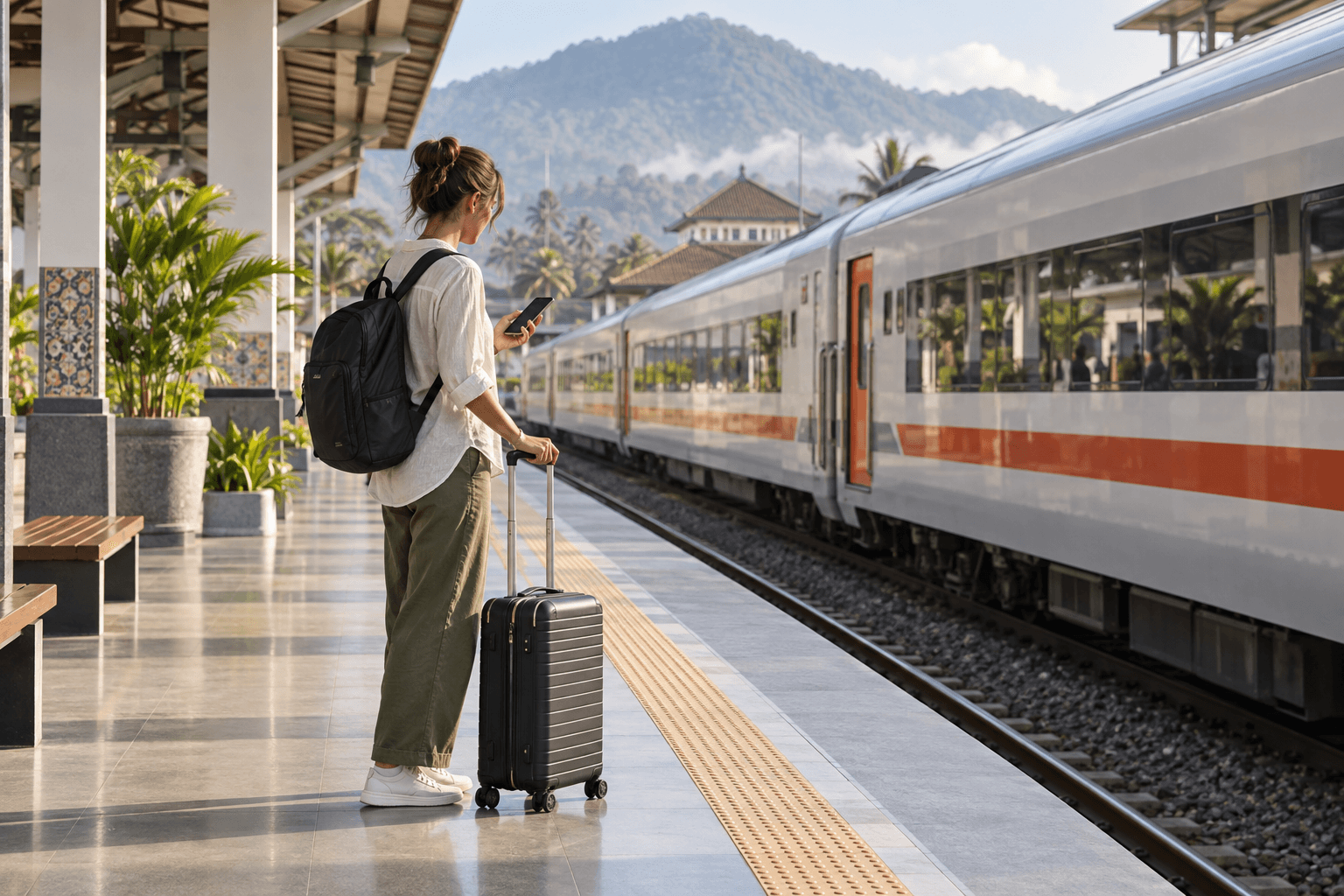
KAI intercity trains connect many useful routes across Java, including Jakarta, Bandung, Yogyakarta, Solo, Surabaya, and cities between them. Rail services also operate in parts of Sumatra, but the network is not a single island-wide system. Access by KAI and KAI's official booking channels provide schedules and tickets.
Confirm the exact station because a city may have several. Jakarta services can use Gambir or Pasar Senen; Yogyakarta can involve Yogyakarta or Lempuyangan; Surabaya uses different main stations depending on the route. Foreign passengers should enter identity details exactly as required and carry the matching passport.
Classes, seat layouts, baggage conditions, and flexibility differ by service and fare. Book earlier around Eid, Christmas, New Year, school holidays, and long weekends, then arrive with enough time to find the correct entrance and platform.
Ferries and fast boats: check the vessel and the sea
Vehicle ferries, passenger ferries, and fast boats serve different routes and use different ports. ASDP's Ferizy platform covers selected ferry crossings, while other routes use separate operators or ticket systems. Never assume one booking site covers every Indonesian island connection.
Confirm the departure port, check-in deadline, baggage handling, vessel type, and whether the ticket includes transfers. Bali alone has several relevant ports, and a booking labelled for one destination may depart far from your accommodation. Ask where boarding actually takes place before payment.
Sea conditions can delay or cancel a service. Use a reputable operator, follow crew instructions, locate the life jacket and exit, and avoid an itinerary with an unprotected flight connection immediately after a boat. Check BMKG marine information and the operator's update close to departure.
Buses, shuttles, and private transfers
Intercity buses and shared shuttles fill gaps beyond the rail network and can be useful on Java, Sumatra, Sulawesi, Bali, and other islands. Service ranges from basic coaches to reclining-seat and sleeper-style buses, but the label alone does not guarantee a particular layout or standard.
Verify the operator, boarding point, destination terminal, luggage policy, rest stops, and expected arrival window. A terminal outside the city can add a long final transfer. For overnight journeys, keep documents and valuables with you, use the seat belt when provided, and tell your accommodation if arrival may be late.
A private transfer can be good value for a group, a remote property, or a late arrival. Get the vehicle type, inclusions, meeting instructions, and final price in writing; clarify parking, tolls, ferry charges, waiting time, and child-seat availability.
Getting around cities and tourism areas
Jakarta has the country's broadest mix of mass transit, including TransJakarta, MRT, LRT, and KRL commuter services. Official Jakarta guidance lists electronic money cards and supported QR or operator applications as payment methods. Payment acceptance changes by mode, so check the operator rather than assuming one foreign card will work everywhere.
Ride-hailing cars and motorcycle taxis operate in many cities, although pickup and drop-off zones can be restricted at airports, stations, ports, hotels, or traditional transport areas. Match the number plate and driver in the app, wear the provided helmet on a motorcycle, and keep luggage size in mind.
Public transport coverage varies greatly outside Jakarta. In Bali and many smaller destinations, the practical choice may be a driver, taxi, hotel transfer, rental vehicle with the correct licence, or a combination. Walking distance on a map may also be uncomfortable because of heat, traffic, hills, or missing pavements.
Choose an accommodation type that matches the trip
Hostels can reduce cost and add a social setting, but compare dorm size, lockers, quiet hours, bathroom arrangements, and late check-in. Guesthouses and homestays range from a room in a family compound to a small professionally managed property; breakfast, housekeeping, and host interaction are not guaranteed unless listed.
Budget and mid-range hotels are often practical for short city stays because reception, luggage storage, lifts, breakfast, and transport access may be easier. Villas can work well for groups and longer stays, but confirm staffing, road access, pool safety, security, utilities, and whether the listing is for the entire property.
Resorts make sense when facilities are part of the holiday. A remote resort rate may exclude airport, boat, or seaplane transfers, meals, taxes, and activities, so compare the complete stay rather than the room price.
Location matters more than a small price difference
Choose an area from the itinerary, then choose a property within that area. A cheaper room on the opposite side of a congested city or island can cost more in daily transfers and lost time. Check the map pin against the written address and recent guest comments about access.
For a one-night connection, prioritise the correct station, airport route, or port over nightlife and scenery. For a longer stay, compare food access, evening transport, noise, beach or terrain conditions, and the distance to the activities you will actually do.
Remote accommodation should provide precise arrival instructions. Ask about the last ferry, road condition, after-dark arrival, mobile signal, power schedule, and cash access before confirming a non-refundable stay.
Review the full accommodation booking
Before payment, review taxes, service charges, deposits, payment timing, cancellation terms, guest limits, bed configuration, breakfast, air conditioning, hot water, Wi-Fi, and accessibility. ‘Family room’, ‘ocean view’, and ‘private villa’ are not standardised promises; read the room-level details.
Use the platform's messaging system for important questions and save written answers. Avoid moving payment off-platform when it removes the booking protection you expected. Be cautious when a new contact sends a payment link or claims the reservation will be cancelled immediately unless you transfer funds.
After booking, save the confirmation, property phone number, map pin, and check-in instructions offline. Contact the property through a verified channel if arriving late or when a transport delay changes the plan.
Connect transport and accommodation into one itinerary
Book the least flexible or hardest-to-replace transport first, then reserve accommodation around confirmed arrival and departure points. Add airport, station, or port transfers next. Activities should come after the basic route works, especially when boats, mountain access, or weather-dependent journeys are involved.
Leave a buffer between separate bookings and keep the final night before an international flight within a dependable connection of the departure airport. Flexibility often protects more of the trip than adding another destination.
- One booking does not protect a separate ticket.
- Recheck schedules 24–48 hours before each transfer.
- Keep one flexible day on complex island routes.
- Store confirmations, addresses, and emergency contacts offline.
Frequently asked questions
What is the best way to travel around Indonesia?
It depends on the route. Flights suit long island-to-island journeys, trains work well across much of Java, ferries serve specific crossings, and buses or transfers fill network gaps. Compare the complete door-to-door journey.
Is train travel available throughout Indonesia?
No. The most useful intercity passenger network is on Java, with separate rail operations in parts of Sumatra and urban rail in selected metropolitan areas. Many islands have no passenger railway.
Should I book Indonesian transport in advance?
Advance booking is sensible for flights, intercity trains, popular boats, and travel around Eid, Christmas, New Year, school holidays, or long weekends. Local urban transport usually does not require the same lead time.
Which accommodation is best for a first trip to Indonesia?
A well-located hotel or established guesthouse is often easiest for a first visit. Choose the area according to your transport and daily plans, then compare facilities and the complete price. Hostels, villas, homestays, and resorts suit different budgets and trip styles.
How much connection time should I allow?
There is no universal minimum. Separate tickets, terminal changes, baggage collection, traffic, ferries, and weather all need larger buffers. Avoid connecting a remote-island boat to an international flight on the same day.
Can tourists use ride-hailing apps everywhere in Indonesia?
Ride-hailing operates in many cities and tourism areas, but coverage and pickup zones vary. Some airports, ports, stations, and local transport areas restrict where app-based drivers can meet passengers.
Sources and further reading
We used the following primary consumer resources to review time-sensitive claims in this guide.
Compare options for your trip.
Continue to Traveloka to check current schedules, availability, and final prices for your travel dates.
Affiliate disclosure. This page contains Traveloka affiliate links. We may earn a commission when you book through them, at no additional cost to you. Commercial relationships do not determine our editorial recommendations.