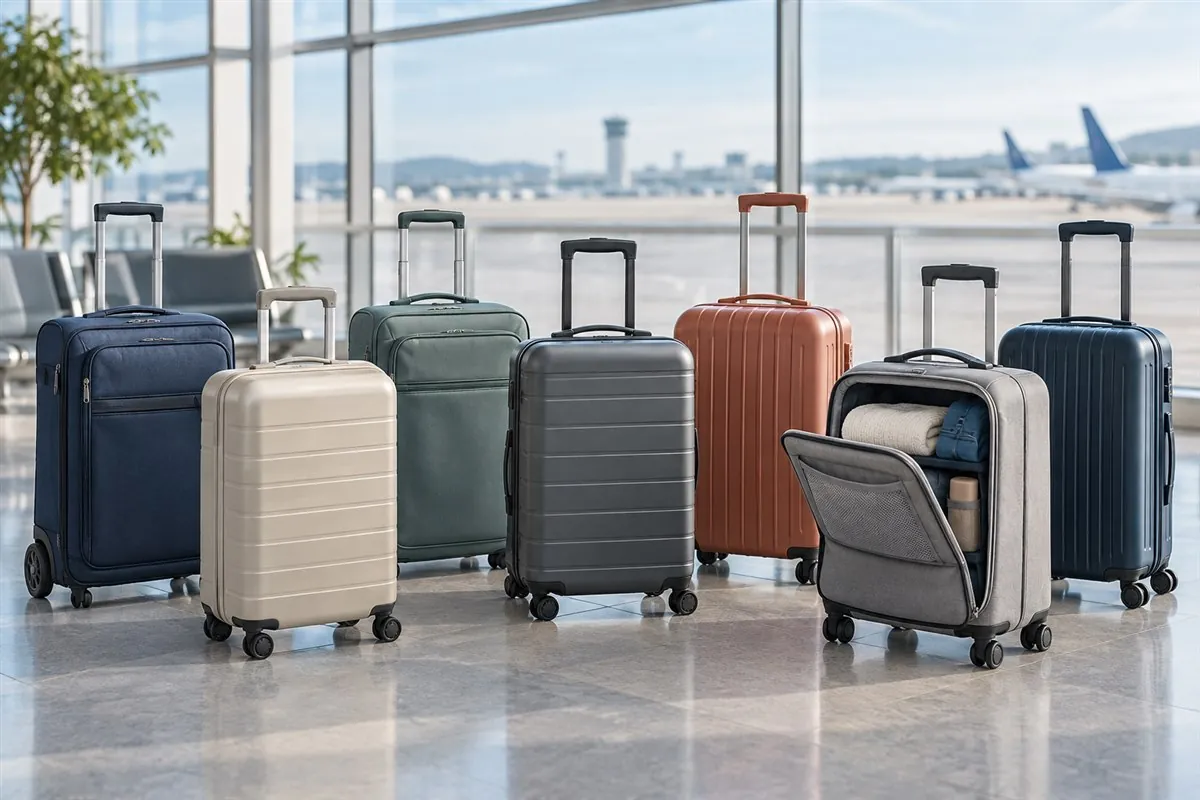
- Seven suitcase types compared
- Cabin-size rules explained
- Durability checklist
- Amazon affiliate-ready picks
What makes a carry-on suitcase genuinely cabin-friendly?
The best carry-on suitcase is not simply the case with the strongest shell or the most five-star reviews. It must fit the operating airline's size and weight rules, remain easy to control through stations and terminals, protect its contents, and survive repeated lifting, vibration and impact. A suitcase that weighs too much when empty can consume a large part of a strict cabin allowance before a traveller packs a single shirt.
There is no universal cabin-bag size. IATA says allowances vary by airline, cabin class and aircraft, although 56 × 45 × 25 cm is a general reference used by many carriers. AirAsia publishes a maximum cabin-bag size of 56 × 36 × 23 cm and a combined 7 kg limit for the cabin bag and small personal item. Singapore Airlines allows one cabin bag up to 7 kg in Economy and Premium Economy, with length, width and height totalling no more than 115 cm. Policies can change and codeshare flights can use the operating carrier's rules, so check every flight in the itinerary before buying or packing.
Published dimensions normally include wheels, handles, side pockets and other protrusions. Measure the actual case rather than relying only on a marketing label such as 20-inch, international carry-on or cabin approved. Expansion zips can also make a compliant case too deep. This guide therefore recommends seven useful suitcase types and explains who each suits. The Amazon buttons initially open tagged product searches; direct links can replace them once the exact seven products have been selected.
- Check the operating airline, fare and cabin class.
- Measure wheels and handles as part of the bag.
- Compare empty weight before capacity.
- Keep a margin below the published limit.
1. A lightweight polycarbonate spinner for most travellers
A well-built polycarbonate spinner is the most balanced choice for travellers who want a hard shell without the weight of metal. Polycarbonate can flex under impact and return toward its original shape, helping it absorb routine knocks. Four double-wheel assemblies make the case easy to roll beside the body in a smooth terminal, and a clamshell layout separates clothing from shoes or laundry.
Look beyond the shell label. Check the complete empty weight, measured external dimensions, wheel attachment points, corner protection, zipper gauge and telescopic-handle movement. Press gently around the wheel wells and handle housing, where forces concentrate. A very thin shell may feel impressive in a product listing yet twist excessively when full. A useful warranty should explain whether wheels and handles are covered and how service works in the buyer's country.
This type suits city breaks, mixed business and leisure travel, and travellers who usually move across paved surfaces. It is less convenient on broken pavements, stairs or cobblestones, where small spinner wheels can catch. Pack both halves evenly because an unbalanced clamshell can tip when a personal item is placed over the handle.
2. A tough polypropylene case for practical durability
Polypropylene cases can be a smart choice when durability, flexibility and price matter more than a glossy premium finish. The material can tolerate regular flexing and is often used in lightweight moulded luggage. It may show scuffs, and construction quality still varies widely, but a thoughtfully reinforced polypropylene case can work well for frequent short journeys.
Inspect the hinge area, zipper track or latch alignment, wheel housings and the points where the top and side handles attach. Internal compression panels are more useful than several loose straps because they stop contents from shifting into the closing edge. Textured finishes tend to disguise scratches better than mirror-smooth shells. If the case uses latches rather than a zip, verify that they close evenly when the bag is normally packed.
Choose this category for family travel, regular domestic flights and anyone who values a forgiving shell. Do not treat flexibility as permission to overpack: a bulging case can exceed the airline's depth limit and place continuous strain on seams or latches. Measure the packed bag at its deepest point.
3. An aluminium-frame carry-on for maximum structure
An aluminium or aluminium-frame carry-on offers strong structure, precise latches and a distinctive premium feel. It can protect rigid or delicate contents from compression better than a soft case. The trade-offs are significant: metal dents rather than flexes, scratches become part of its appearance, and the empty case can be much heavier than a plastic alternative.
This option makes sense only after checking the airline's weight allowance. A beautiful case that weighs four or five kilograms empty leaves little packing capacity on a seven-kilogram route. Test the latches, gasket alignment, handle play and wheel replacement system. Avoid claims that imply the case is indestructible. Dents can occur during normal use, and a rigid frame can be difficult to close when contents extend beyond its exact volume.
It best suits travellers carrying organised, valuable equipment who accept the weight and price. Keep essential electronics and spare lithium batteries compliant with aviation rules regardless of how protective the suitcase feels. Physical protection does not change restrictions on what may travel in the cabin or hold.
4. A soft-sided expandable carry-on for flexible packing
A soft-sided carry-on is useful for travellers who want an external pocket, a single deep packing compartment and a little flexibility around irregular items. Quality woven fabric can resist abrasion, while reinforced corners and protective rails reduce direct wear. Unlike a clamshell, it can open in a narrow hotel room without occupying twice its footprint.
Check fabric density and coating, seam quality, zipper paths, wheel protection and the stiffness of the rear panel. An external laptop pocket is convenient only if its padding does not consume too much interior space or push the packed dimensions beyond the limit. Expansion is useful after arrival or when the case will be checked, but it should stay closed for a strict cabin journey unless the expanded measurement remains compliant.
This is a strong choice for road-and-air itineraries, business travellers who need documents quickly, and anyone who dislikes dividing belongings into two shell halves. It offers less resistance to crushing and rain than some hard cases, so protect sensitive contents inside separate sleeves and do not assume ordinary fabric is waterproof.
5. A front-opening hard-shell case for laptops and documents
A front-opening hard-shell suitcase combines exterior protection with faster access to a laptop, passport wallet or work documents. It is particularly useful at security screening and during a train connection because the main case does not need to open across the floor. Some designs open from the front as one deep compartment; others add a separate padded technology door.
The front section changes how space and weight are distributed. Confirm the approved laptop size, padding, lockable zips and whether the pocket steals depth from the clothing compartment. Never leave a laptop in a case that is unexpectedly gate-checked; move valuable electronics, spare batteries, medicine and documents to a personal item. A front-heavy case should remain stable when the handle is extended and the pocket is loaded.
Choose it for short business trips or remote work when a laptop must be accessible. Travellers who rarely carry technology may get better capacity and fewer zips from a conventional shell. Test the layout with the actual charger and laptop rather than trusting a diagonal screen-size claim.
6. A two-wheel carry-on for rougher streets
Four-wheel spinners dominate airports, but a two-wheel rollaboard remains valuable on uneven pavements, cobblestones and longer outdoor approaches. Its larger recessed wheels generally roll over cracks more easily and occupy less interior corner space than four protruding spinner assemblies. The bag tracks behind the traveller instead of drifting sideways on a slope.
Look for wheels with replaceable hardware, a protective kick plate, strong axle support and enough clearance to prevent the fabric from scraping. Pulling the bag places more load on the arm than rolling a spinner beside the body, so handle height and grip shape matter. Two-wheel cases also need room behind the traveller and can be awkward in a crowded aisle.
This is the practical pick for rail journeys, heritage-city streets and travellers who value wheel durability over effortless multidirectional movement. Check the full length including the recessed wheel housing, and remember that a long telescopic handle does not change the airline measurement when fully retracted.
7. A compact underseat roller for strict or short trips
An underseat roller is the smallest recommendation in this list. It can suit overnight trips, travellers who struggle to lift a case into an overhead bin, or itineraries where access to essentials matters more than maximum capacity. A structured underseat bag may also work as the personal item on some fares, but that status depends entirely on the airline's published personal-item dimensions.
Measure height, width and depth with every pocket filled. Aircraft seat structures and aisle positions differ, so a product described as underseat is not guaranteed to fit every seat. Choose quiet wheels, a stable base, a pass-through sleeve if it will sit on a larger suitcase, and an interior that holds a change of clothes without crushing medicine or electronics.
This category rewards disciplined packing. It is ideal for one- or two-night journeys and as a mobility-friendly alternative to an overhead case. It is a poor choice when its rigid frame takes up most of a very small allowance. Compare it with a lightweight personal-item backpack before deciding which shape uses the permitted space more effectively.
How to judge suitcase durability before buying
Durability comes from the complete construction, not one impressive material name. Read reviews for the exact size and model because marketplace pages can combine feedback across several variants. Look for repeated evidence about wheel loss, stuck handles, split zips, cracked corners and warranty response. A few scratches are cosmetic; a wheel housing separating from the shell is a structural failure.
Check whether consumable parts can be replaced. Wheels attached with accessible screws, documented spare parts and repair centres can extend the life of a case. Cycle the telescopic handle at several heights, load the top carry handle, inspect stitching or rivets, and make sure zips travel smoothly around corners. If ordering online, keep packaging until the case has been measured, packed and rolled on different surfaces within the return period.
Security features also need context. A built-in lock can discourage casual opening, but no suitcase is a safe. Keep passports, money, medication and valuable electronics with you. Where a security authority may inspect baggage, use an accepted lock system or leave the appropriate access available according to the route's rules.
A cabin-luggage checklist before every flight
Open the booking and identify the operating carrier, fare, cabin class, number of permitted pieces, maximum dimensions and combined or per-piece weight. Repeat this for every segment, especially on connections and codeshares. Measure the packed suitcase at its widest points, including wheels, fixed handles and bulging pockets, then weigh it with the personal item if the airline applies a combined limit.
Assume overhead space can run out even when the suitcase meets the rules. Pack documents, medication, valuables, power banks and spare lithium batteries in a removable personal-item pouch. If staff gate-check the suitcase, take that pouch into the cabin. Secure loose straps, close expansion zips and attach contact details without exposing unnecessary personal information.
The best recommendation is the smallest durable case that fits the real itinerary. A lightweight spinner will suit most airport-focused trips; a two-wheel rollaboard earns its place on rough streets; a front-opening case supports frequent laptop access; and an underseat roller serves disciplined short trips. Choose the construction around the journey, then confirm the exact product against current airline rules before paying.
- Operating carrier and fare checked
- Packed bag measured and weighed
- Expansion zip closed
- Power bank kept in removable cabin pouch
- Warranty and returns reviewed
- Contact details placed inside the case
Frequently asked questions
What size suitcase is cabin-friendly?
There is no universal size. IATA notes that allowances vary by airline, class and aircraft. Measure the complete suitcase, including wheels and handles, against the operating airline's current policy for every flight.
Is a 20-inch suitcase always allowed in the cabin?
No. The 20-inch label does not provide exact external dimensions, and airlines apply different size and weight limits. Check the manufacturer's measured dimensions and verify them yourself.
Which suitcase material is most durable?
Construction matters as much as material. Polycarbonate balances impact resistance and weight, polypropylene can be flexible and practical, aluminium provides strong structure at a weight penalty, and quality fabric can resist abrasion while offering external access.
Are two wheels or four wheels better for carry-on luggage?
Four spinner wheels are agile on smooth floors, while two larger recessed wheels often handle uneven streets better. Choose according to the surfaces and transfers in the itinerary.
Does the cabin baggage measurement include wheels?
Airline and IATA guidance generally treats wheels, handles, pockets and protrusions as part of the external dimensions. Measure the complete packed case.
Can a compliant carry-on still be checked at the gate?
Yes. IATA notes that cabin bags may be moved to the hold when stowage capacity is exceeded. Keep essential documents, medicine, valuables and restricted spare batteries in a removable personal item.
How heavy should an empty carry-on suitcase be?
Lighter leaves more payload under a strict allowance, but there is no single ideal weight. Compare empty weight with the operating airline's limit and the durability features you actually need.
Are the suitcase links Amazon affiliate links?
Yes. Eligible Amazon links use the Associate ID jalajahtravel-20. Qualifying purchases may earn this site a commission without increasing the buyer's price.
Sources and further reading
We used the following primary consumer resources to review time-sensitive claims in this guide.
Browse cabin-friendly luggage in one place
Check the external dimensions, empty weight, warranty, seller and return policy against your airline before ordering.
Affiliate disclosure. As an Amazon Associate, we may earn from qualifying purchases made through eligible links on this page, at no additional cost to you. Product availability and specifications can change; our editorial guidance remains independent of commercial relationships.