- Community-led tourism
- Marine and forest protection
- How to check green claims
- Practical lower-impact trip planning
What eco-tourism means in Indonesia
Eco-tourism is more than a room surrounded by trees. At its best, it combines a nature-focused experience with protection of the place being visited, meaningful benefits for local people and learning for guests. A wildlife tour that crowds animals, a beach hotel that discharges waste badly, or a village visit staged without local control should not earn the label just because its marketing uses green colors.
Indonesia's islands make the topic especially concrete. Reef trips, mountain hikes, forest walks, rice-field visits and village stays all depend on living landscapes and communities. Tourism can help fund conservation and local livelihoods, but it can also add pressure through waste, water use, traffic, habitat damage and high-volume visitation. The useful question is not whether a trip sounds 'eco.' It is how the operator manages those trade-offs and who benefits from the money spent.
This guide describes observable directions in Indonesian tourism as of 2026, using government, tourism and standards-body sources. It does not claim a national ranking of the fastest-growing activities: comparable demand data for every category would be needed for that. Instead, it shows practices travellers can actually look for and check before they book.
- Ask who owns and operates the experience.
- Look for measurable practices rather than vague 'eco-friendly' promises.
- Follow the destination's own conservation rules, even if an operator suggests shortcuts.
1. Community-run tourism villages are becoming more structured
Indonesia's desa wisata, or tourism villages, offer a way for residents to shape visitor experiences around local culture, food, agriculture and landscapes. The Ministry of Tourism published a 2026–2045 tourism-village roadmap study that discusses classification, institutions, funding and monitoring. A roadmap is a policy direction, not proof that every village already meets the same standard, but it shows how central the village model has become in planning.
Nglanggeran in the Yogyakarta region is a useful example. Indonesia's official tourism portal describes local homestays and activities related to its ancient-volcano landscape, cocoa cultivation and village life. A visitor can learn from residents and spend directly with local providers rather than treating the village as a brief photo stop. The experience should still be chosen with care: ask whether the host wants visitors at a particular time, whether activities are community-run and whether the group size fits the location.
The next step for this trend is quality, not just more village names on a map. Training, transparent pricing, fair work and visitor limits matter as much as a new listing. Government data also documents a programme for assessing sustainable tourism villages against national destination guidelines. Travellers should distinguish an official certification from a general 'village tourism' label and verify the current status of any claim.
2. Coastal tourism is being linked to reef and mangrove care
A beautiful underwater view is not evidence that a marine tour is sustainable. Snorkelling, diving and boat traffic can damage reefs when anchors are dropped on coral, visitors stand on living structures or wildlife is chased for photographs. The stronger trend is to make conservation part of the visitor experience and local economy rather than treating the sea as scenery that will always recover.
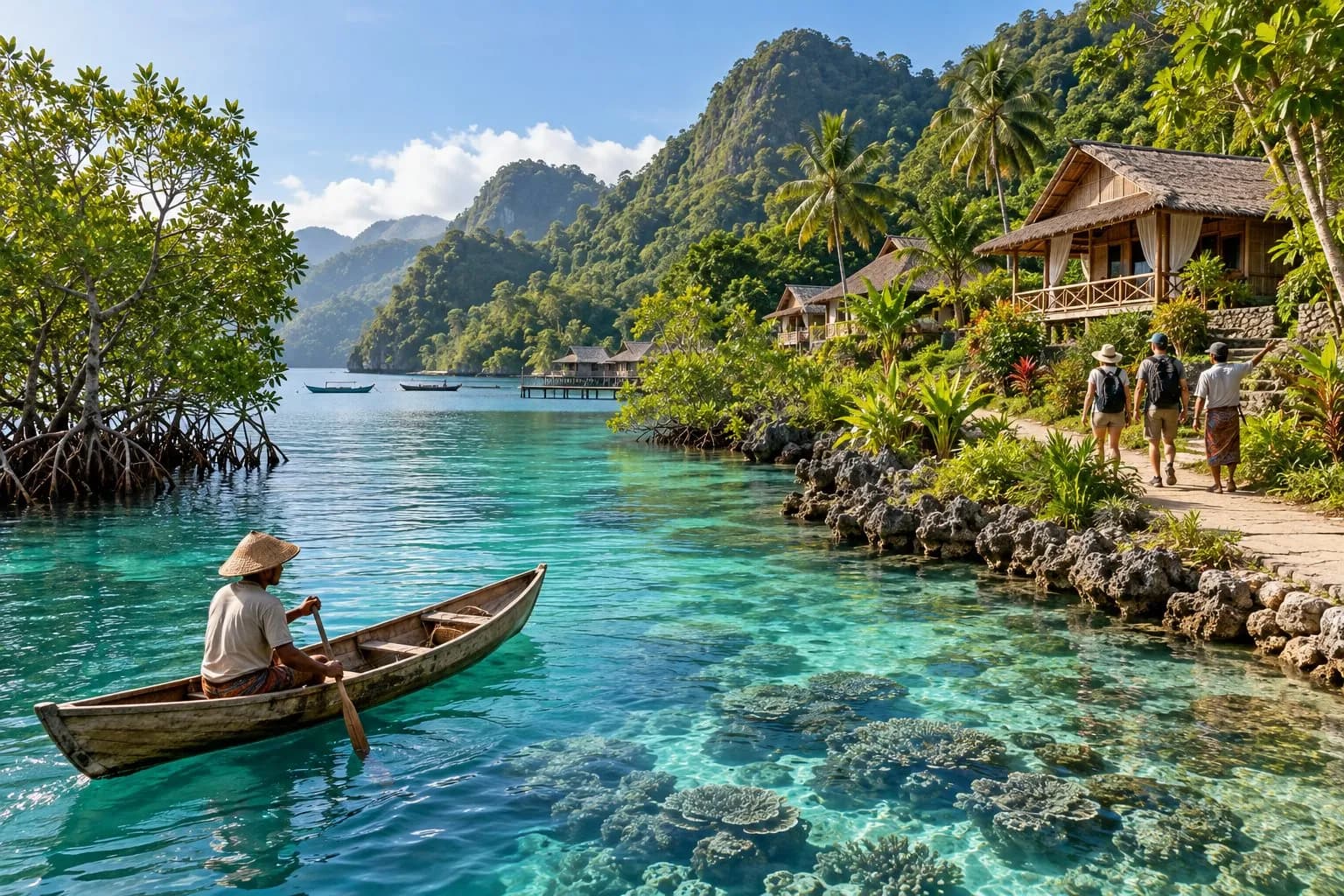
Pemuteran in north-west Bali is one example highlighted by Indonesia's tourism portal for community-based coral restoration and cultural activities. East Java's Clung Mangrove Conservation at Tiga Warna is another: the official destination profile describes local management through a foundation and visitor learning about mangroves and coastal ecology. These are examples of programmes, not a promise that every nearby boat or accommodation provider follows the same standards.
Before booking, ask whether the operator uses moorings instead of anchoring on reefs, briefs guests on no-touch rules, manages waste on the boat and employs local guides. Do not assume a coral-planting activity is beneficial merely because it offers a photograph with a fragment; ask who maintains the site, what method is used and whether participation is actually appropriate for visitors. Sometimes the most useful contribution is paying a responsible local guide and leaving the habitat undisturbed.
3. Wildlife visits are putting more attention on carrying capacity
Protected areas need rules because popular viewpoints and wildlife encounters can be harmed by their own popularity. Komodo National Park is a clear case: its UNESCO listing recognises both terrestrial and marine importance, while conservation documents discuss managing visitor numbers at particular sites. The existence of such controls does not mean every proposed limit has been applied everywhere or remains unchanged; it means travellers should take park access seriously.
Choose an authorised operator, follow ranger instructions, keep the required distance from animals and use established paths. A tour that promises a close wildlife selfie or a restricted-site shortcut is giving you a warning sign, not a premium experience. Boat safety and waste handling should be considered alongside conservation. The cheapest day trip may become poor value if it ignores basic visitor or environmental standards.
This principle extends beyond Komodo. Forest trails, turtle nesting beaches and nesting-bird areas all have seasons and sensitive zones. Current access may change because of weather, ecological conditions or management decisions. Check the responsible park authority shortly before travel and accept a closure without pressuring guides to bypass it.
4. Cultural landscapes are part of sustainable travel
Eco-tourism is often reduced to beaches and forests, but landscapes shaped by people also need careful stewardship. UNESCO recognises Bali's subak system as a cultural landscape tied to water management and the Tri Hita Karana philosophy. A rice terrace can be a working agricultural system, not just a backdrop for a café. Visitors should stay on permitted paths, avoid damaging fields and pay locally where access or guiding is organised by the community.
The same idea applies to village crafts and food production. A cooking session, weaving demonstration or farm visit is more meaningful when local practitioners set the terms, are paid fairly and can explain their work in their own way. Buy a product because you value its maker, not because a tour says all souvenir shopping is automatically sustainable. Ask whether raw materials and production practices match the claims.
Longer, slower visits can also give more value to one community than a rushed sequence of stops. That is a planning principle, not an automatic carbon calculation: a longer stay may still have impacts. But spending more time in fewer locations often reduces repeated transfers and creates room to learn from hosts instead of treating culture as another item on a checklist.
5. Green standards are becoming more useful—and more important to read
A growing number of hotels and destinations use environmental language, which makes independent standards valuable. The Global Sustainable Tourism Council, or GSTC, publishes criteria covering management, social and economic benefits, cultural heritage and environmental impacts. Its destination framework offers questions that travellers can adapt even when a property does not hold a certificate: who monitors resource use, how workers are treated and whether local communities have a voice.
Indonesia has a Sustainable Tourism Destination Standard listed by GSTC as a recognised standard. But the words matter. GSTC explains that recognition of a standard means the standard aligns with its criteria; it is not the same as saying every business in a destination has been certified or audited. A hotel's self-described 'eco' badge is another different claim. Look for the exact certificate holder, certifying body, scope and valid dates before treating a logo as proof.
Simple questions can reveal more than a marketing page: does the hotel measure water and energy use? How does it handle wastewater and solid waste? Are local staff employed in skilled roles? Does it explain wildlife and cultural-site conduct to guests? A smaller locally owned stay may do some things well without formal certification, while a certified operation still has trade-offs. Compare evidence rather than choosing on image alone.
- Check what an award or certificate actually covers.
- Ask for specific water, energy and waste practices.
- Distinguish a recognised standard from a certified business.
6. Local enterprises and green-skills training are receiving attention
Sustainable travel depends on the people delivering it, not only on visitor behavior. In June 2026, Indonesia's Ministry of Tourism described a Green Tourism MSMEs training programme and said its 2025 activity reached more than 973 tourism businesses in Yogyakarta. That is a reported programme reach, not evidence that all those businesses achieved a particular environmental result. The distinction matters when assessing any trend claim.
For travellers, the practical implication is to notice who delivers the value. A locally run guide service, family homestay or small restaurant may keep more spending in the destination than a package that imports most services. Yet local ownership alone is not a complete sustainability guarantee: staff welfare, safety, resource use and conservation rules still count. Ask how the business works and pay a fair price for skilled guidance.
When you can, book directly with the local provider for specialised village or conservation activities, while using reputable platforms to compare transport or accommodation. Verify payment and cancellation arrangements whichever channel you choose. A sustainable choice should also be a safe, clear one for the visitor and the host.
7. Lower-waste, slower itineraries are replacing the checklist mindset
Single-use plastic, unmanaged rubbish and rushed transport are visible problems in many destinations. The move toward refill points, reusable bottles, sorting and better waste systems is worthwhile, but a reusable bottle does not cancel out every impact of a long journey. Consider the whole itinerary: number of inter-island flights, length of stay, transfer efficiency, accommodation practices and whether a fragile site benefits from your visit.
For a one-week holiday, choose one region or two nearby bases rather than trying to touch five islands. A Bali trip might combine a few days around a community-managed cultural landscape with a coastal stay where responsible marine activities are available. A Yogyakarta trip can pair the city with one tourism village rather than three long daily drives. For remote marine areas, allow enough nights to make the complex transport worthwhile and leave buffers for weather.
Avoid blanket claims that a train, boat or flight is always the greenest choice without a route-specific comparison. Occupancy, distance, fuel and local alternatives all matter. What you can control immediately is reducing unnecessary transfers, choosing shared transport where practical, packing light, respecting local water constraints and buying only the activities you will actually use.
A practical checklist for spotting greenwashing
Before you pay, search the operator's name and read its own explanation of environmental and social practices. Look for details that can be checked: a named local partner, a current certificate, a park permit, a clear animal-welfare rule or a description of how waste is removed. Phrases such as 'nature-friendly,' 'carbon-neutral' or 'supports the community' are starting points for questions, not conclusions.
Ask who receives the conservation fee and what it funds. If a tour claims to restore coral, ask who monitors the results. If a lodge claims to protect a forest, ask whether it is on legally permitted land and how local access is respected. For an offset claim, ask what emissions were counted and who verified the project. You do not need a perfect answer to every question, but a credible provider should be willing to discuss its trade-offs rather than offer only slogans.
The final test is fit. Choose an experience that matches your abilities and interests, follows current rules and allows people who live there to benefit. You may still use a plane, hotel or booking platform; the aim is to make each part of the trip more deliberate. Indonesian eco-tourism will be stronger when demand rewards good management, local expertise and honest reporting rather than the most persuasive green label.
- Prefer specific evidence over broad environmental slogans.
- Check official park rules and the scope of any certificate.
- Ask how fees benefit local people or conservation work.
- Avoid wildlife-contact activities and shortcuts into closed areas.
Frequently asked questions
What is eco-tourism in Indonesia?
It is nature-focused travel that should help protect the environment, benefit local communities and improve visitor understanding. A green setting or marketing label alone is not enough.
What are examples of community-based eco-tourism in Indonesia?
Official tourism profiles describe village-led experiences in Nglanggeran, Yogyakarta; community coral work around Pemuteran, Bali; and coastal conservation learning at Clung Mangrove Conservation in East Java. Verify the current operator and programme before booking.
Is Raja Ampat or Komodo automatically an eco-tourism trip?
No. A protected or biodiverse destination can still be harmed by poor visitor behaviour and operations. Check authorised access, group size, wildlife rules, waste handling and local benefits for the specific tour.
How can I tell whether an eco-hotel claim is credible?
Ask for the exact certification and its current scope, then review water, energy, wastewater, waste and employment practices. A recognised standard is not the same as certification of every hotel that mentions it.
Does slow travel always have a lower carbon footprint?
Not automatically. Transport mode, distance, occupancy and length of stay matter. Fewer unnecessary transfers and longer stays in fewer places are useful planning choices, but a real comparison needs route-specific data.
Where should I verify park and conservation rules?
Use the responsible park authority and the official destination or tourism agency for current access, permits and restrictions. Recheck close to departure because conditions can change.
Sources and further reading
We used the following primary consumer resources to review time-sensitive claims in this guide.
- Indonesia Ministry of Tourism — tourism-village roadmap study 2026–2045
- Indonesia Ministry of Tourism — sustainable tourism village standards dataset
- Indonesia Ministry of Tourism — Green Tourism MSMEs training 2026
- Indonesia Travel — Nglanggeran Tourism Village
- Indonesia Travel — Pemuteran Tourism Village
- Indonesia Travel — Clung Mangrove Conservation
- UNESCO — Bali subak cultural landscape and Komodo National Park listings
- GSTC — destination sustainability standard and recognition explained
Compare stays and activities, then verify the details
Search your dates and destination, and ask each provider about local employment, waste, water, wildlife rules and transport before booking.
Affiliate disclosure. This page contains Traveloka affiliate links. We may earn a commission when you book through them, at no additional cost to you. Commercial relationships do not determine our editorial recommendations.